As we study energy in science, we decided to put the sun's energy to work for us. We constructed solar ovens from simple shoe boxes and foil. We picked a bright, sunny day to "bake" our hot dogs for about 1 1/2 hours. Then.... mmmm.... LUNCH!
Hot Dog - now we're cookin! on PhotoPeach
Showing posts with label Second Grade. Show all posts
Showing posts with label Second Grade. Show all posts
Wednesday, May 20, 2015

Wednesday, March 4, 2015
This Teacher Attends a Writing Conference!
.JPG)
I took pages and pages of notes. Thank goodness I had the weekend to process everything I learned. Here are just a few of the highlights:
The Units of Study were written for us to teach
authentic writing. Writing that exists
in a library or a book store – writing that is written for an audience. This is public, published writing – not
personal journal writing.
Students will gradually develop their knowledge of
conventions. First accept their approximations
and then correct them.
Teach students skills and multiple strategies to do
them. We need multiple strategies. For example, writing with a strong lead is
the skill (what to do). Strategies to do
this (how to do) include setting the scene with weather, starting with a moment
of action, starting with the character’s dialogue, etc.
Writing is a process. The less sophisticated the writer is… the
more stories he/she will need to produce.
Students will go through the process independently. Kindegarteners will produce a lot more
stories than second graders. Students
need to go through the process many times and will learn something new each
time. As the children have more ideas
and develop an understanding on conventions, etc. they will take longer on
their writing. (Gather ideasà
Draft à
Revise à
Edit à
Gather ideas à Draft à
Revise, etc.) Start new writing, instead
of making “this” piece better, teach them to make the “next” piece better.
Students need many pieces of writing, not one long
story. They need practice generating
lots of ideas. Ask them, “Where do you
go all the time? What do you see all the
time? What do you do all the time?”
Children need to write independently and be able to
work through the process. Have a writing
center in your classroom. Release your
control and allow children access to what they need. Your just right paper should have a few more
lines than you can fill up in your first go around. Children will need paper choices. Even second graders should be writing across
many pages. Each thought belongs on a
page. This is to give them a sense of
writing in paragraphs.
Celebrate the work not just the finished product.
For every flap, re-write, edit, cross out, etc.
that is a place where you've grown as a writer. You've made your work better.
Mid-workshop editing break. As adults, we write and edit as we go. It’s a habit of mind. To help teach this to children, stop during
the writing time and tell them you are going to have a 1 minute editing
break. Set the timer for 1 minute while
everyone reads their work looking for a specific thing to edit – could be
capital I, could be punctuation. Make
the necessary edits then and there and move on after a minute passes.
Strategies to Habits: put a piece of computer paper in a page
protector and divide it into four squares.
Each section should have a post it note with an individual writing goal
in it. Check these goals during writing
conferences. When the strategy has
become a habit move to a poster/chart/pocket.
No more than four at a time. Look
What We've Accomplished!
During a teacher meeting this week, I presented what I learned to my second grade ELA team. We all left the meeting with renewed writing and teaching energy!
If you ever have the chance to learn from these trail blazing professionals at TCRWP, I highly suggest you take it!
Wednesday, February 25, 2015
Have I Got A Book For You!

We are finishing up Bend II in Lucy Calkin's Second Grade Unit of Study: Writing About Reading - Opinions. In this unit, we have been writing letters which persuade our classmates, friends, and family members to read our favorite books.


Tuesday, January 20, 2015
Charting our learning on a Continuum
 |
| To begin our lesson, the teachers drew a long line across the front board. Each student got a sticky note to write on. We talked about riding a bicycle. The children thought about their skill level on bike riding and wrote a few words explaining how comfortable they are with bicycle riding. |

 |
 |
| Students placed their sticky notes on the continuum. Notes on the left side stated that the children were not comfortable on a bike or could not ride a bike. Students that were very comfortable riding a bike placed their note in the middle or toward the right side. Students on the extreme right side noted some tricks that they could do on a bike. |
 |
| Less comfortable on a bike. |
 |
| Middle of the road (so to speak). The real learning in this lesson took place during our discussion. The teachers asked the children if it was possible to move up and down on the continuum. How would the children on the left side move to the middle? Who could they talk to? What could they do? We applied the continuum to other situations... surfing, reading, writing, etc. Are you always on the left side? Middle? Right side? When you find yourself in a situation that you want to improve, how can you go about it? |
Monday, May 12, 2014
Improving Narrative Writing by Setting Goals
Today we taught Session 7 from the Second Grade Narrative Writing Unit of Study by Lucy Calkins. This comes at the end of Bend I and is the perfect time to reflect on what we put in our writing and think about what we can do better. This lesson, in fact, is about setting goals for your writing. We passed out the narrative writing checklist and the pre-assessment on demand writing piece that students produced at the beginning of this unit. They could already see where their writing has improved.


 |
| Here are some examples of student work along with the rubrics that the teachers used to evaluate the pieces. |
Next, we talked about setting goals. How could we use the rubric (and narrative checklist for 2nd and 3rd grade) to make our writing better? Students wrote their goals for themselves on sticky notes and placed them on our Jot Lot.
Some of the goals were right on target.
 |
| My goal is to develop my story. My goal is to work on transition words. Write less jumbled together. My goal is to work on my ending. My goal is to work on my lead. |
 |
| My goal... to add more pages. My goal is that I want to get more on the second grade track. My goal is to work on my ending. My goal is to bring characters to life. I need to write more excitement. We're looking forward to Bend II and improving our stamina. Like an athlete, we will be exercising our writing every day to develop our skills and I'm sure, achieve our goals! |
Thursday, April 24, 2014
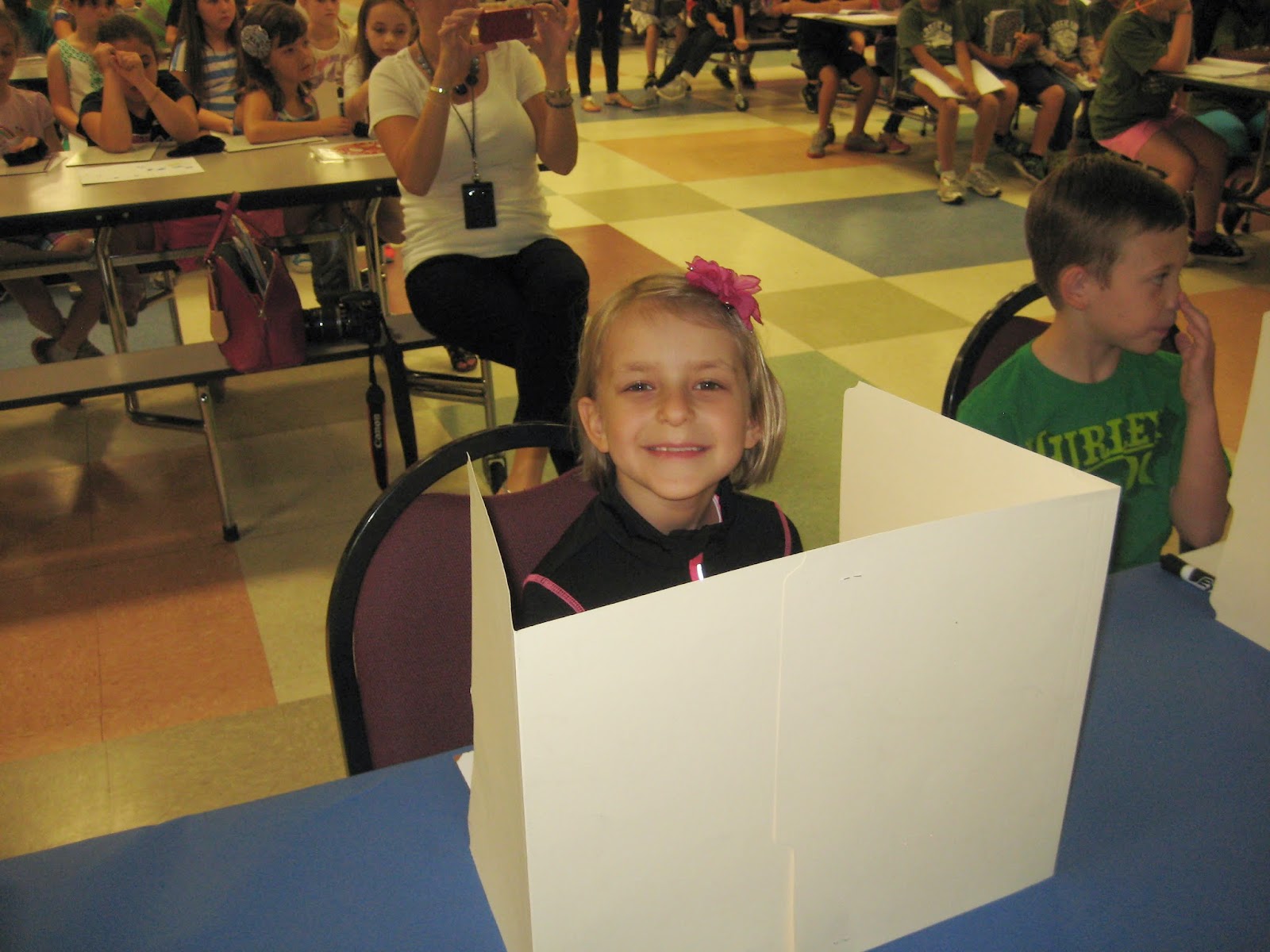
Math Brawl




Wednesday, April 23, 2014
Who loves a good read aloud?? WE DO!!
Our second grade day is set up perfectly! We have a 2 1/2 hour ELA block in the morning. At 11:40 we go to lunch, followed by recess, and then resource. When we come back from music, art, or PE we spread out on the carpet in the gathering area and relax for some read aloud time. Mrs. Morris shares some of her favorite chapter books with us.
 |
| Right now we are reading Beverly Cleary's Ramona Quimby Age 8. The main character is eight years old and starting third grade. Just about our age as we finish our second grade year. |
 |
| Before this chapter book we read Cynthia Rylant's The Van Gogh Cafe. |

Some other favorites from this school year include Dan Gutman's Jackie and Me, Louis Sachar's Sideways Stories fromWayside School, and Katherine Applegate's The One and Only Ivan.
Tuesday, April 15, 2014
Titanic Report of Information
Our second graders are publishing their Information Reports as we wrap up Lucy Calkins Unit of Study for Lab Reports and Science Books. Connor wrote his report about the Titanic, a subject he is PASSIONATE about.


Because his report is so interesting, I e-mailed Robert Ballard. What a wonderful surprise to get the mail today and find a letter and autographed picture addressed to Connor!


If you'd like to see Connor's entire 14 page report, please click the link below.
We couldn't be more proud of the work our students are doing as we implement the new Units of Study in second grade this year!
Thursday, March 6, 2014
Stop and Jot
Today we taught our students something very important. Our first thought is not our BEST thought.
Let me say it again.. your first thought is NOT your best thought.
 In the past we told our kids to make connections. They made shallow connections such as, I've used chopsticks before, I like to eat rice, I have a cat. Now we know better. We need deep connections. Everyone uses their background knowledge to connect to a story/movie/game/etc. But what else do you think?
Today we introduced a Jot Lot. Our kids already know about stopping and jotting. This gives them a place to show off their work. No names are needed, you simply place your sticky note on your number. Reading each others notes helps to grow their thinking.
 We crafted our lesson from Falling In Love With Close Reading.
 We looked at the character in a narrative story using the point of view lens from chapter 5.
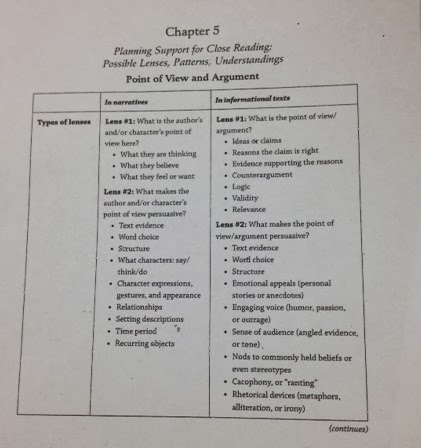
 Then we read the book Everybody Cooks Rice.
 Hmmm. What is the main character thinking? What text evidence do you have to support this? We wrote our first thought on an orange sticky note. Then we read the book AGAIN talking with our partners about what was happening and used a new lens, what does the author want you to learn from this book. What is her point of view? What evidence do you have to support your thoughts? This time when we stopped to jot on pink stickies, our thinking was better. First thoughts - she was looking for her brother. It was dinner time.
Second time around -
 all her neighbors have different skin colors but cook the same foods in different ways.
 Carrie learned about different cultures and what they eat. She also learned that everybody eats rice.
Our closing conversation was about people being basically the same, but also different. We located each country on a map, of course, and talked about the variety of cultures in Carrie's neighborhood.
I'm sure, the more we use the Jot Lot, the better our responses will be. But it's not just for reading, this can be used as a place for exit tickets in math, and for scientific thinking as well!
Let me say it again.. your first thought is NOT your best thought.
Today we introduced a Jot Lot. Our kids already know about stopping and jotting. This gives them a place to show off their work. No names are needed, you simply place your sticky note on your number. Reading each others notes helps to grow their thinking.
Second time around -
Our closing conversation was about people being basically the same, but also different. We located each country on a map, of course, and talked about the variety of cultures in Carrie's neighborhood.
I'm sure, the more we use the Jot Lot, the better our responses will be. But it's not just for reading, this can be used as a place for exit tickets in math, and for scientific thinking as well!
Monday, March 3, 2014
The Beginning of Our Own Information Reports
We are entering Bend 3 in our Information Unit of Study and our students have chosen their own topic to write about. Some topics bouncing around are: gymnastics, rollerblading, skateboarding, swimming, playing basketball - soccer - baseball, biking, and playing the piano. We have drafted a Table of Contents and are working on chapters of our books.
Here are some pages which we found particularly helpful and engaging...
As we study nonfiction mentor texts we expect to see labeled diagrams and 'how to' instructions pop up in our reports. Students can't wait for writers' workshop each day!
Here are some pages which we found particularly helpful and engaging...
 |
| This page from Will's book explains the importance of having your bike examined regularly to stay safe. |
 |
| Briella dedicated a page to appropriate gymnastics attire. |
 |
| Courtney made sure to bold the words she will add to her glossary. She also encouraged her reader by saying don't give up. Soccer wasn't easy for her when she was little. |
 |
| Logan's introduction tells the reader to get healthy and strong by using pedal power and riding a bike instead of taking the car. |
Monday, February 3, 2014
Informational Writing via Lucy Calkins


We began our new unit of study by Lucy Calkins, Grade 2 Information: Lab Reports and Science Books. Our students designed and conducted a force and motion experiment using ramps.

Each child gets a 5 page packet and a writing partner. They create a hypothesis by asking a question starting with, "I wonder what would happen if..." Then they list the materials they will need and the steps (procedures) they will follow. On the next two pages they write their predictions (hypothesis) of what will happen. The classroom is filled with energy and excitement during the writers' workshop where the children conduct their experiments. Some of our students wondered if the height of the ramp would matter - 6 inches vs. 12 inches. Others predicted that a small car would roll farther than a linker cube. To gather accurate results, they tested each experiment three times and recorded their data. Finally, the last page in the report documents the results and if the student's prediction was correct (conclusion).
In our classroom, we only had one plastic toy ramp and several small toy cars, but our clever kids created ramps using big books, white boards, clipboards. and paper towel rolls.
Stay tuned for the next bend in the unit when we will be creating catapults to launch cotton balls!
Subscribe to:
Posts (Atom)